Sunday, September 21, 2014

Bye bye birdies...?

"Shrinking and shifting ranges could imperil nearly half of U.S. birds within this century."

Baltimore Orioles

The National Audubon Society is a group conducting a study which "is a comprehensive, first-of-its kind study that predicts how climate change could affect the ranges of 588 North American birds" (audubon.org).  This group reported that in the several upcoming decades, as the climate becomes warmer, many different species of birds will have to move on from their current locations... endangering a reported 588 species of birds. The report by Gary Langham, the chief scientist of the NAS, talks about this effect in North America.
Baird's Sparrow


The report talks of 126 species of North American birds that will have much less space and areas to live in due to the specifications of their organisms and the changes in the climate in the areas they currently reside in -- therefore potentially making them endangered. Another 188 species were said to lose more than half of their range, and will have to face different soil and foods. All of this is said to be in full effect by the year 2080.
Turkey vulture     American crow
On the other hand, birds like the turkey vulture and American crow, which are known as birds that are disliked, are said to tremendously expand their ranges. The American robin and blue jay are also said to be seen a lot more in additional other areas.


"Bye, Bye, Birdies? Species Will Shift with Warming Climate." NBC Science. NBC News, Sept. 2014. Web. 21 Sept. 2014.

Thursday, September 11, 2014

100,000 Elephants Killed by Poachers in Just Three Years

http://news.nationalgeographic.com/news/2014/08/140818-elephants-africa-poaching-cites-census/
Brad Scriber
August 18,2014

“During 2011 alone, roughly one of every twelve African elephants was killed by a poacher.” The most endangered area is central Africa where most of the killings take place. It is happening mainly because of the search for ivory although there has been a ban on the trade in this precious material. The main problem is that the survival of elephants is in danger, since there has been a 64% decline in elephant population in recent years. However, it is very difficult to know the exact number of killings since there is no precise information on the total number of elephants in Africa. There is some data but it is over a decade old. In 2002 a program called MIKE (Monitoring the Illegal killing of Elephants) was created to try to establish the number of elephants killed. There will also be the Great Elephant Census in 2015 which will try to determine the total elephant population. However, it is very difficult to make aerial estimates since it is difficult to spot forest elephants from the air. The latest analysis claims that the elephant population is seriously declining and that even without the killings it is getting lower by 3% every year. Besides the obvious, the disappearance of elephants could have serious negatives effects on Africa’s animals and plants. It will reduce genetic diversity and the distribution of this species and its ecological role. Also, elephants are considered “megagardeners of the forest” because their lifestyle benefits their habitat.

Personally I feel sorry for the elephants because they are one of my favorite animals and they are beautiful, majestic creatures. Obviously, killing animals for profit is bad and everyone knows that. If we take a deeper look, we have to wonder what we are doing to our planet. Besides things such as wars and pollution, killing innocent animals is the worst thing to do. If we continue like this there will be no animals left on this planet. Not only it will disturb the natural balance that we have, it will also make the Earth a very sad, deserted place. Without the animals, the plants will disappear too and there will be nothing left.  


Where the Smog Ends Up: The Giant Sequoia Forest


Figure 1: The largest treeing the world;
General Sherman.
By Jeff Wheelwright

SEPTEMBER 10, 2014

The concern is now focused on the Sequoia National Park, which is home to some other largest trees on Earth, including the "General Sherman" which is the largest tree on Earth [Figure 1]. The national park, unfortunately, is situated near the San Joaquin Valley, which is an industrial and agricultural region. Because of the pollution emitted from nearby sources, Sequoia National Park has the worst air quality in the United States. 

Origin of problem
The main reason for this occurrence are the west winds, which bring pollution from the San Francisco Bay, Fresno, nearby highways, farmlands and summer wild fires. Typically, the polluted air would keep flowing west, if not for the Tehachapi Mountains, which ricochet it back, and it slowly rises. That mix of different harmful chemicals includes ozone, nitrogen oxide, evaporative organic compounds, and residue from pesticides. However, ozone doesn't just simply arrive, it is formed from nitrogen oxide and different hydrocarbons with reaction to sunlight. Being considered as a very unstable compound, it is difficult to fight, and quite harmful to the tissue of the flora in the park.

Figure 2: View from the Sequoia National Park Mountain

Effect on National Park
The smog supposedly "creeps in" in the morning along the river, and as seen in Figure 2, gives a misty coat to the national park. This however, has been controlled over years, and noticed as a pattern, to occur mostly during the summer, when the temperature is very warm, and no clouds are there to cover the ozone from developing. The largest harm was seen on not the mature and tall trees, but the smaller and young generation of trees, especially pines. We can see that this is a problem, mainly because 

Improvements & Concerns
In comparison to 1982, the air quality in Sequoia National Park improved, however at its best year (2013), it was still the worst in history of all national parks in America. Initially, the San Joaquin Air Control District has been promoting electric-powered technology instead of those which emit polluting gasses, as well as educated drivers on carpooling and unnecessary idling. However, scientists predict, that the National Park's air quality will be resorted to natural state by approximately 2096.


I believe that this is a major thing that we don't necessarily pay attention to as much. Most people say that we should stop pollution for ourselves, to improve OUR health and our lives, rather than also notice that there are animals and plants suffering from our doings. As mentioned in the article, "California has told federal regulators that 'natural conditions' won't be restored until 2096.", which is somewhat a long term effect which we notice now, not before, and it's not like we change our lifestyles so much to adjust them just to this one park in particular. Majority of the people probably don't even realise that their grass mowing is so harmful to the growth of pine trees. All of this however, has a action-reaction into an exponential growth of ozone. In theory, pollution has an effect of climate change, whether it's extreme droughts or extreme floods. There is a possibility, that over the next year, if the ozone emission continues, and droughts overcome California, more wildfires will be created, more sunlight will be there to allow ozone to form, and it will all double, triple etc. Therefore, when we consider helping in creating a solution to this problem, we have to remember that there are other factors which have a miraculous impact on this, such as the pollution in Los Angeles or river pollution, which comes along into the park. 
In my opinion, this is a very important thing to look into and care about, especially that this park is home to many species of animals as well as plants. The unique things about it are the largest trees, and with the ozone damaging younger generation trees, we won't be able to maintain the habitat they have now, just destroy it and cause deforestation and desertification in the upcoming centuries. Considering the fact that people nowadays are so dependent on technologies which pollute the environment, the government and the people should come up with better solutions to those long term problems, starting with raising awareness, because no one knows much about it. 

Water Footprint

Ruth Matthews
25 August 2014
Jovana Curcic


This article talks about one of the most important themes concerning all the living parts of our planet-water deficiency problems. To be honest, this was the first time I read about water footprints. A few years ago, I heard of the ecological footprint, or more precisely the carbon footprint, meaning the negative impact of people's activities and energy use on the Earth, but I don’t quite remember much about it. (This is why I think that this course is really necessary for many of us). Anyways, the water  footprint was something I read about for the first time, and it made me think about a variety of aspects concerning our everyday lives.
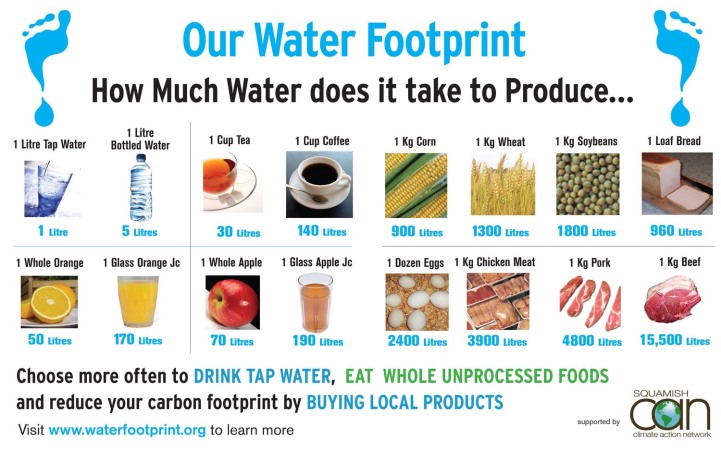
What is the water footprint? According to Ruth Mathews, director of the Water Footprint Network, the water footprint is “the impact of our activities on freshwater resources”. In other words, everything that we do has some impact on freshwater. For example, a cup of morning coffee requires 140 l of fresh water (for beans to grow), or one pair of jeans which is approximately one kilogram of cotton requires even 10,000 l  fresh water!!! And the most endangered are the producers of resources, which are often the poor countries such as Columbia and India. According to the article, the average consumption of a person in the UK is about 150 l of water per day, but this number rises to more than 4,500 litres per day, when all the water hidden in the water footprint is calculated. Some other examples are seen in the picture below.

 So, why do we even need water and why bother about the water footprints that we leave behind? The demand for freshwater is growing rapidly around the world specifically because of all the species around, climate change and irresponsible resource use. If we know that almost 750 million people worldwide do not have access to clean water at all, we should be aware of our consumption, and introduce water footprint in our decisions and choices.
Since we depend so much on water, we overuse it with the things we do in our everyday lives; for example making coffee in the morning and buying a new pair of jeans. Not only are we wasting it, but we’re also causing harm to the environment. So, each of us should be aware about water consumption and be a responsible consumer. We pollute water all around the world, and this usually leaves the rivers running dry and the species being endangered because of the contaminated water. What can we do to reduce water pollution? We should minimize the use of pesticides, herbicides, and fertilizers, and we should NOT dispose of these chemicals,motor oil, or other fluids into the sanitary sewer system. We should use a minimum amount of detergent/bleach when washing out clothes. We should avoid using garbage disposal, keep solid wastes solid, etc. We shouldn’t throw litter into rivers, lakes, or oceans (These were some ideas that I read from a different article).
It is incredible how unaware of the surroundings we really are, and the amount of attention we give to the environment is extremely limited! Reading this article, I found myself thinking about many different aspects of this topic, and the question that came up in my head made me worry about the future- what if we lose all the water that we have one day? What would be with the existence of many future generations and what should we do to do to fix this problem? I think that for the beginning, each of us should start from his/her own closet and ask himself: “Do I really need so many T shirts?”

Bibliography:


Wednesday, September 10, 2014

SpaceX Rocket Base to Be Built Near Endangered Sea Turtle Nesting Beach

September 8. 2014
Melissa Gaskill for Scientific American

“Can rockets and endangered species co-exist?” The private Space Rocket Company SpaceX wants to build a launch site right next to a place where many endangered live. This is in Boca Chica, in Texas right next to the border of Mexico. A large variety of Sea turtles live there including the Leatherback, Loggerhead and Kemp’s Ridley Turtles. These all are sea turtle types that are endangered from extinction. On the other Hand the U.S. Federal Aviation Administration gave SpaceX the approval to apply to licenses to build the Launch pad. In that wildlife Park although there is a Sea Turtle Restoration Project which could be endangered by the project of SpaceX. The Turtle Type Ridley is nesting in the Wildlife Area and the number of them increased until 2009, when the Nesting decreased by 25%, and then in 2014 to 45% less than 2009. The Decline is said to be caused by the oil spill of deep water horizon. Yet the number of loggerhead turtles had increased to 1100 nesting in 2014. On the other hand in Kennedy Space Center in Florida, Rockets and Animals already co-exist since 50 years. This was only made possible by Government watching closely to minimize effects. The company SpaceX has already started to speak with Biologists to make clear if turtles will be able to live there.

The article although says that it could be possible that it is much more complicated to secure the animals than in Florida due to that SpaceX is a private company and the Wildlife Parks are mostly owned by private holders. They although say that they will want to secure the animals by themselves, as they have talked to many agencies already. If the turtles won’t be protected, it could be possible that up to 91 Turtles nesting could be killed or harmed, as they breed up to 3 clutches in a season meaning a strong loss. Next, SpaceX wants to remove 6 Hectares of Land and 1 Hectare of Water Land, but they are cutting off another Hectare of wetland. It can so be expected that the turtles could move, which would be a big loss for the region. A true negative side is driven up by that they don’t want to say anything else than their statement, meaning there could be more damage. Furthermore, the Government will only allow the construction, if the environment is safe. Moreover the article says that there is a bad Formal oversight meaning that the environment could be endangered by the construction of the project.


I would really answer my question from the beginning as a strong No, in which endangered species can’t co-exist with rockets and Technology of this Kind. After my research, I found that the Kemp’s Ridley sea turtle and the Hawksbill sea Turtle are Critically Endangered. This is a level on the IUCN Red List that is just over “Extinct in Wild” and then comes Extinct. This is really sad, as the Nature should not lose these animals as they are almost extinct. Also the other Turtle types are endangered and no one of them has any concern. So I think that this is really the wrong place for something like a launch pad for rockets, as they can always explode or malfunction, which then means that the habitat of these animals could be lost forever, and then they could be extinct. Also the U.S. Federal Aviation Administration stated that “may affect, is likely to adversely affect”. This comes back to the species, so the administration already sees that there could very likely be a negative effect on the endangered species. Truly this will really be a wrong decision to build a launch pad at a place where it is expected that there will be damage to the wildlife around it. This means that another animal type could go extinct like over 800 others, which will show the Humans that we can’t always solve the problems with technology, but we must stop some things that will affect the nature negatively.

Thursday, September 4, 2014

World’s Largest Dam Removal Unleashes U.S. River After Century of Electric Production

 August 26. 2014
Michelle Nijhuis for National Geographic 
http://news.nationalgeographic.com/news/2014/08/140826-elwha-river-dam-removal-salmon-science-olympic/
http://images.nationalgeographic.com/wpf/media-content/photos/000/829/cache/82956_990x742-cb1409001825.jpg

The US was a leader in dam building in the 20th century, using the electricity to power economic development, as well as a clean, and greenhouse gas free alternative energy source. However now Asia, Africa and South America are following their example and this could be a potential problem, as the US has come to see. Though it benefited greatly from dam building, the US has recognized that in some cases, these dams were causing damage to the environment, which was greater than their benefit to the whole country. The Elwha River is one of the rivers that was blocked off by a dam, and is one of the most affected.
The project started in the end of 2011, with the start of the removal of two dams. The Glines Canyon dam and the Elwha Dam. The most important aspect of the project is the fact that now after three years; species that once inhabited the area are migrating back. Salmon for example are migrating past the dam site, while trees and other vegetation are sprouting in the canals once filled with water. While the sediment that was previously trapped is now creating beaches in the connection of the river and 
the sea.


Figure 1, Shows where the dams were located, and how much of the river they blocked.

The two dams were widely regarded as a positive change, because they powered the growth of the whole peninsula. They powered the whole industry in the region, which was the timber industry. However the dams began doing more and more damage, endangering the fish and the well-being of the Elwha Klallam tribe. They protested for the protection of salmon runs, and in the 1980s they joint several environmental groups and started to lobby for the dam removal. The biggest step forward occurred in 1992 when the government purchased the dams from the timber companies, and explored the idea of removing them. After many years of lobbying and great effort in 2011, September the concrete removal process began. Senator Bill Bradley said "The reflection you see in Elwha is an image of what our country is capable of," he told the crowd”


I believe that this is a small step in the right direction, because it is providing, or re instating the natural habitat of several species, such as salmon. From the example of this dam removal project we can learn that if we have the will to work against pollution and climate change we can achieve results. The fact that such a small community is managing to cause change and to be a part of the largest dam removal project, only shows that no matter how small organization is, if they remain active and vocal they can achieve results. In this case it was the removal of a dam, actually 2. These dams were causing damage to the surrounding area, not only by flooding a region, but also by many animals who inhabited the area were forced to migrate, especially the fish , but also other animals on land, because dams produce great amounts of noise. Though dams are helpful 

Air Problems Only Get Worse With Climate Change

August 20, 2014
By
http://www.nytimes.com/2014/08/21/business/international/cities-air-problems-only-get-worse-with-climate-change.html?_r=0

The real definition of global warming is "a gradual increase in the overall temperature of the earth's atmosphere generally attributed to the greenhouse effect caused by the increased levels of carbon dioxide, CFCs, and other pollutants.
As we know global warming is the biggest threat now in the 21 century. From 1880 until now there is a big change in global warming, the earth is getting warmer and warmer, north and south pole are slowly melting, that's why we have all the big floods.
As you can see in the graph below the global land ocean temperature is very rising, in 1900 it was very low, and when 2000 came the temperature you can see that the temperature is rising. The sea is also a big factor of climate change.
The threats form climate change are many: Extreme weather, big amounts of snow pack, altered ecosystems and rising of the seas. I am sure that humans have influenced the waring of the atmosphere and the changes in the ocean, also the reduction in snow and ice, and the sea level.
As you can see in the picture. Our planet is very hot, and it is getting even hotter. Here are some examples that can help us to save the world. ("Install solar panels, do not leave appliances, defrost old fridges and freezers regular, replace old single gazed windows with double- glazing, take a shower instead of a bath, use less water, recycle, reduce waste, plant a tree, switch to green power, don't waste fuel. For concision i know that everybody can do something about global warming and climate change, each day our planet is getting worse, and we need to stop that.