Saturday, March 9, 2013

The Making of Antarctica's Hidden Frojds


Title of the Article: The Making of Antarctica's Hidden Frojds
Source: Science Daily.

As the 3rd quarter began we started to talk about the Grand Continent named Pangaea. The super continent had all of the today's continents in one 'larger' continent - and this was estimated to be about 300 million years ago. We also discussed how the movement of the tectonic plates can affect speciation as well as evolution. The 11th grade class was taught that many species got separated when the tectonic plates moved, thus speciation occurred where one specie began to 'evolve' and adapt to the new area it was headed to, while the original specie did not go through the same change. The constant change and movement of the plates is responsible for the great diversity of animals we have today.  I chose to write about this article since it related to the unit we were studying. Even though it does not mention anything related to speciation, it elaborates on the fact that between 20-30 million years ago erosion occurred in the Antarctic, however it is not visible (without digging) since the evidence can be found beneath the massive Lambert Glacier (which covers a large segment of the isolated continent).  

"Glaciers can carve deep valleys quickly -- and did so on Antarctica before it got so cold that the most of it got covered by one or two miles of thick, stationary ice." I find it fascinating how our planet will never remain the same - but with the momentum of the tectonic plates it will alter.  The research done by this team has been a challange for them. As mentioned in the article: scientists mostly hike the area before coming up with its topography - while collecting some rock samples and sending them back to the lab. It is difficult in Antarctica's case since 97% of its composition is ice.


By Mihajlo

Thursday, March 7, 2013

Erratic Climate Change in the Himalayas

Nepalis Adapt to Changing Climate
by Kieran Cooke and Dailyclimate.org
Published February 22, 2013 at ScientificAmerican.com

The Himalayan ranges have dealt with many climate issues in relation to global warming, in addition to resource conservation conflicts. Recent arguments have emerged between China, Pakistan, India and Nepal regarding the mismanagement of water resources that rest on the nations boarders as well as the construction of dams. Due to the tension between these nations, river flow and management data is often classified by the governments. The International Centre for Integrated Mountain Development is an intergovernmental body that gathers information about the environment of the multiple nations, as well as notes the effect of climate change. They recently conducted a surveyed 6000 households about the effects of climate change, as well as their attitudes towards the controversial issue. Early results show that around 80% of the families surveys in the Koshi River basin noticed higher temperatures, with 90% noting unusual rainfall patterns. Valdemar Holmgren, a specialists at the Centre stated that, "early indications from one area in Nepal clearly show people are fully ware of changes in climate patterns." He then goes on to explain, "in many areas farmers are changing crops in order to adapt to changing climate conditions. But for many, it is very hard." In addition to climate issues, the changing societal organizations and migration patterns have lead to many struggles for local businesses. Another organization working to monitor climate change in this ecologically unique area is the United Nations Environment Program. They have concluded that from 1982 to 2006, the temperature of the region has raised by 1.5 degrees Celsius  Also, it is recorded that on average, temperature rise approximately 0.06 degrees every year. Overall, climate change has taken a significant toll of the highly complex and unique ecosystems of the Himalayan mountain ranges, greatly effecting the lifestyles of the people.

This article is fascinating in that it discusses the societal impact of climate change, rather than the more commonly covered environmental impact. The struggles of the Nepalis farmers to deal with the changes the erratic weather patterns clearly demonstrates the current effects global warming, illustrating how this issue must be dealt with immediately before peoples' livelihoods are compromised. Also, the Himalayas are a remarkable and singular mountain range that must be preserved for future generations of explorers and scientists to study. This article also confronts another important idea: international competition for resources. The arguments between the nations of this region over the misuse of freshwater resources shows how vital conserving these natural resources and communicating internationally about them is to successful environmental management. Also  it could foreshadow a dismal future created by the over-pollution of freshwater, consequently leading to the shortages of the biologic necessity  In conclusion, this articles discussion of societal climate change effects, as well as disputes arising from resource management, two issues that are extremely important to environmental preservation and conservation. 

Saturday, March 2, 2013

Where the Wild Things Go … When There's Nowhere Else


http://www.sciencedaily.com/releases/2013/02/130228155757.htm
February 28th, 2013

Recently, ecologists have found that some endangered species, especially primates and large cats, have found shelter from human disruption in mangrove and peat swamp forests. These biomes are located in the coastal regions of tropical areas within Africa and Asia. The mangroves are characterized by thick vegetation, trees adapted to growing in salt-water and a wet, swampy forest floor scattered with layers of fallen leaves, dead branches and logs. Humans are relatively uninterested in mangroves, which provide animals facing extinction a place to seek shelter from humans.

Katarzyna Nowak, an ecologist and evolutionary biologist at Princeton University, created a list that consisted of 60 primates and 20 felids (large-cats) that were found to distribute their time between their natural habitat and swamp forests in Africa and Asia. The list included tigers, which are currently facing extinction with only 3200 tigers predicted to be alive today.

One problem that some of the animals seeking refuge in these swamps may come across is the lack of freshwater and food sources. Some animals also lack mobility in these forests since few mammals are actually adapted specially to survive in these environments. There are however few species of cat who are accustomed to fishing as well as crab eating macaques. These species may be better accustomed to surviving in the swamp forests.

Research has shown that in fact 55% of the Old World monkeys, such as baboons and macaques, either live in the mangroves all year round, seasonally, or whenever they need to seek shelter. According to the Wildlife Conservation Society, in 2008 a staggering 125,000 lowland gorillas were found to be living in the swamp forests of Lake Tele, Republic of Congo. This population of gorillas found was larger than was thought to exist in the wild. Lake Tele is extremely remote and is therefore somewhat inaccessible. As well as gorillas, the Bengal tiger also lives solely in the Sundarbans, the largest mangrove forest in the world located in Bangladesh.

I personally believe that it is quite horrible that we have forced certain species to abandon their natural habitats due to increasing pressure caused by human overexploitation of these species and their respectful resources. It is however relieving to know that many of these species are able to survive in the mangroves and avoid extinction such as the lowland gorillas in Lake Tele. I chose this article because it goes hand-in-hand with the topic of loss and maintenance of  biodiversity in ecosystems.


Friday, February 22, 2013

"Monster" Goldfish

Monster Goldfish Found in Lake Tahoe
by Tanya Lewis and LiveScience
Published February 21, 2012 at ScientificAmerican.com

Goldfish are proving to cause significant problems for the ecosystem of Lake Tahoe in the United States. Aquarium dumping has released these organisms into their nonnative habitat, where they threaten the ecological organization of the lake, famous for its clear waters. Researchers study the lake recently discovered several large goldfish, measuring 1.5 feet long and weighing 4.2 pounds. According to scientist Sudeep Chandra of the University of Nevada, Reno, they have, "found a nice corners where there's about 15 other goldfish... [and there's] indication that they were schooling and spawning." The introduction of this new invasive species greatly threatens the local ecosystem. First of all, it introduces a new predator for native fish and this could lead to an increase resource competition. Secondly, the fish release certain nutrients that cause algae blooms, which can be disastrous for an ecosystem and prevent aquatic plant growth. Aquarium dumping has become a serious issue in the United States. According to researcher Sue Williams, "Globally, the aquarium trade has contributed a thirds of the world's worst aquatic and invasive species." Studies have also shown that 20-69 percent of Texan fish owners dispose of unwanted fish in local ecosystems. Aside from this, aquaculture, live seafood, live baiting, and fishing and recreation vessels are also leading to the introduction of nonnative species to local environments.
The introduction of invasive species into new ecosystems is a very serious issue which threatens the local populations. The goldfishes' presence in Lake Tahoe could prove fatal to many native organisms. Algae blooms are known for greatly harming habitats and leading to the rapid reduction of aquatic plant growth, removing a vital group from the food pyramid. Another interesting aspect of this story is the rate at which the fish adapted to their environment. Normally, the fish are very small; in Lake Tahoe, they grew to astonishing sizes, showing that significant mutations have taken place. By educating the general population about the dangers of invasive species introduction, as well as the importance of conserving local ecosystems would greatly lead to the reduction of aquarium dumping. In conclusion, the introduction of nonnative species to new environments could greatly harm the local ecosystems and actions should be taken to educate the public of those dangers. 

Saturday, February 9, 2013

A new theory of genetic inheritance

"Do Plants 'veto' Bad Genes?
by Heidi Ledford
Nature: International Weekly-Journal of Science

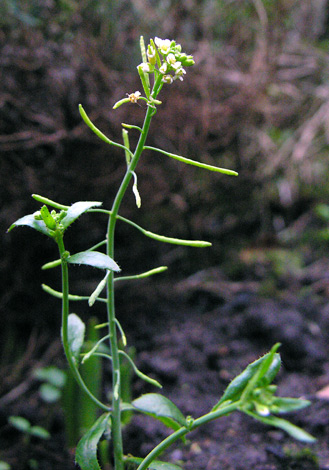
Thale cress (Arabidopsis thaliana)
Studies by Dr. Susan Lolle of the University of Waterloo propose that plants may be able to reject mutated parent genes in favor of healthier grandparent genes. Her work in 2005 claimed that genes from a grandparent generation of Thales cress (Arabidopsis thaliana) appeared in grandchildren, despite them being absent from the parents genomes. Scientists theorize that the appearance of ancestral genes could come from RNA, or an outside source of DNA. However, there has been many challenges to the validity of this study after several researchers were unable to replicate Lolle's results. To combat this skepticism, she has repeated the experiment multiple times, to reaffirm her earlier findings. Another area of criticism for this experiment regards the polymerase chain reaction (PCR) and its connection to possible pollen contamination. Lolle claims that they have limited the contamination for the experiments and performed enough trials to further reaffirm her data. Recently, another group of researchers has gotten the same results, though scientists are concerned about pollen contamination in regard to their experiment.

I agree with Animesh Ray of the Keck Graduate Institute of Applied Life Science who claimed that, "If we believe in the veracity of the experiments, these are very intriguing observations." These are fascinating results, that if proven could change the way we think about plant heredity and even evolution. However, further experimentation by international groups before it confirmed. Like any new study, extensive research must be conducted with a varsity of organisms to validate the results. The ability of organisms to reject mutated traits, in favor of ancestral ones is a fascinating concept that could help explain evolutionary patterns or even offer potential of helping deal with hereditary illness in a medical context. This new theory of gene selection reminds me of the article on epigenetics I wrote about last month, where organisms expressed different traits, despite having the same genetic information. In conclusion, the emergence of new theories involving genetic inheritance show great potential for explaining evolutionary patterns or helping prevent DNA-linked diseases. 

Thursday, February 7, 2013

Obesity in Dads May Be Associated With Offspring's Increased Risk of Disease

A new research from Duke Medicine has shown that a father's obesity may be one of the reasons the the child has a bad health to begin with, and the raised chances of getting cancer. A recent study featured in BMC medicine directly links the paternal genes to the illnesses of their children. Before, it was though that most of the genetic predispositions for such diseases were given from the mother's side, but new research shows that that is not true. Before this study, most of the offspring's health problems were correlated with the mother's behavior (such as smoking or drinking), the amount of exercise, and her environment. Now, we have understood that this is not completely accurate since a father's lifestyle can also affect the life of the children- and their health. A connection has been found that children with overweight fathers are more prone to get certain cancers- such as ovarian cancer and colorectal cancer. Also, these children are more likely to develop an eating disorder- often overeating, undereating, and diabetes. This study has showed us how it is important to take care of your health even before you are planning on having children, because an unhealthy lifestyle can directly influence them and their health. 

Desert bacteria could help boost crop yields

Name: Desert bacteria could help boost crop yields
Author: Wagdy Sawahel
Date: 06.02.2013.
Publication: Environmental News Network

Researches from the UAE (United Arab Emirates) isolated strains tolerant to drought and salt of Rhizobia - a bacteria that fixates nitrogen once it is inside the root of legumes. There is a possibility that this bacteria could help with stopping desertification in arid Middle East, as well as North Africa. It could boost agriculture in those regions as well.


The bacteria lives in a symbiosis with their host, as they exchange nitrogen produced by the plant during photosynthesis. This is used for improving the soil quality. This discovery could lead to improvement of production of leguminous plants which are common in arid environments (according to a study published by the Emirates Journal of Food and Agriculture in february, carried out by researchers from the Dubai-based International Center for Biosaline Agriculture and the Birla Institute of Technology and Science from Dubai)

This article deals with a similar topic as one of my earlier ones, and I decided to talk about it as I feel that dealing with desertification is an important issue. I'm glad that more and more countries are finding ways to stop it, and boos agriculture.